Ventilation
Ventilation is the process of removing stale, moisture-laden air and replacing it with fresh air. The right approach depends on the property, the source of moisture and whether the problem affects one room or the whole home. Ventilation should be assessed alongside heating, insulation and damp diagnosis, particularly after retrofit work.
Estimated reading time: 19 minutes
Short on time? Use the 'Sections in this article' column on the right to jump to the info you need.

Ventilation is the process of bringing fresh air into a building and removing stale, moisture-laden air. In homes, it helps control the water vapour produced by everyday activities such as cooking, showering, washing clothes, drying laundry and breathing. When moisture builds up, it can condense on colder surfaces such as windows, external walls, ceilings and corners. Over time, repeated condensation can create damp conditions, encourage mould growth and damage paint, wallpaper, plaster, silicone sealant and more.
In busy rooms where moisture is regularly generated, such as kitchens and bathrooms, ventilation is especially important. Extract fans, background ventilators, trickle vents, windows and whole-house ventilation systems can all help move humid air out of the property and replace it with fresh air.
As well as high levels of moisture, stale indoor air can accumulate pollutants such as pet dander, dust mites, mould, mildew and other allergens. It may also have high CO2 levels. All of these things are hazardous to health, especially in those with compromised immune systems e.g. the elderly, people with health conditions and children. By providing the home with a regular supply of fresh air, ventilation measures also help to keep homes free of pollutants.
Where condensation is the main problem, improving ventilation can form an important part of the solution. However, keep in mind, when moisture is entering the house from the exterior, rising from the ground or leaking from pipework, the building defect must be addressed directly.
The right approach starts with understanding how moisture is entering or forming inside the building.
There are two main categories of ventilation: natural and mechanical. Most household types of ventilation system can broadly be sorted into one of these two categories.
Natural ventilation uses pressure differences to move air through a building. Wind creates higher pressure on one side and lower pressure on another, while warm air rises and escapes through higher openings. Cooler outdoor air then enters through windows, trickle vents or other purpose-provided vents. For this airflow path to work, openings must remain clear and internal doors may need undercuts or transfer grilles.
Mechanical ventilation uses fans to provide more controlled airflow. Extractor fans remove moisture at source in kitchens and bathrooms. Continuous extract systems, including dMEV, maintain low-level extraction and increase airflow when needed. Positive input ventilation supplies filtered air, normally from a loft, which encourages stale, humid air to leave through available leakage paths and vents. Ducted systems can supply and extract air across several rooms.
Keep trickle vents, wall vents and air grilles open and clear. Use working extractor fans in moisture-producing rooms and open windows for short periods of rapid ventilation. Persistent condensation problems may require additional extraction, passive ventilation or a whole-home system.
Keep existing vents open and unobstructed, use extractor fans in kitchens and bathrooms and open windows for short periods when moisture levels rise. Where condensation affects several rooms, consider whether the home needs improved passive or whole-house ventilation.
Opening windows can provide rapid ventilation and help remove humid air after activities such as cooking or showering. However, occasionally opening windows may not provide enough consistent ventilation for the whole property and leaving windows open for prolonged periods may cause the home to become cold.
Effective moisture control may also require working extraction fans, passive vents or a suitable mechanical ventilation system (such as a PIV, In-Line or dMEV Fan).
Keep existing vents open and unobstructed, use extractor fans in kitchens/bathrooms and open windows for short periods when cooking, cleaning or drying clothes. Where condensation affects several rooms, consider whether the home needs improved passive, mechanical ventilation or a combination of both.
Trickle vents should generally be kept open and unobstructed so they can provide background ventilation. Closing them may reduce draughts temporarily, but it can also restrict the route through which fresh air enters the room. UK Government guidance advises leaving trickle vents open, even during winter.
Ventilation replaces stale indoor air with fresh air from outside. A dehumidifier recirculates indoor air and removes water vapour as liquid water. Dehumidifiers can support humidity control and laundry drying, but they do not provide fresh air or replace suitable ventilation.
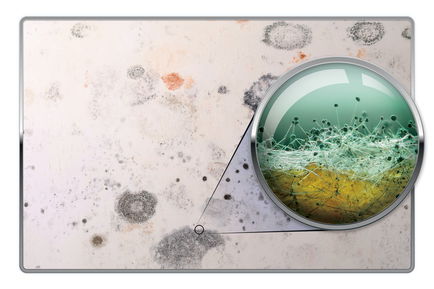
Ventilation can help control the conditions that allow mould to develop, but it will not remove existing growth from affected surfaces. Cleaning mould without addressing inadequate ventilation, condensation, leaks or other building defects may allow it to return. Only controlling the underlying moisture source will stop mould from returning.
Loft-mounted Positive Input Ventilation (PIV) is generally intended for suitable properties with loft access and a cold pitched roof. The building layout, existing extract ventilation, heating, airtightness and sources of damp should be assessed by a professional before installation. PIV can support whole-home air movement, but it does not replace appropriate extract ventilation in kitchens, bathrooms and utility rooms.
Ventilation introduces outside air, so some heat loss is unavoidable. However, controlled ventilation is more effective than relying on uncontrolled gaps, draughts or leaving windows wide open for long periods. The system should provide enough air exchange to control moisture while limiting unnecessary draughts, noise and discomfort.
Possibly. Replacement windows, insulation and draught-proofing can reduce the uncontrolled air leakage that previously allowed moisture to escape. Ventilation should therefore be reviewed whenever retrofit work changes the airtightness of a property. Government guidance states that energy efficiency work should not make the existing ventilation provision worse.
Keep a regular cleaning schedule to ensure that passive vents, trickle vents and all grilles are clean and unobstructed. Extract fans should be cleaned regularly, while PIV and other whole-house system filters should be inspected and replaced in accordance with the manufacturer’s instructions. Performance should be monitored, while ducts and all controls should also be regularly checked.
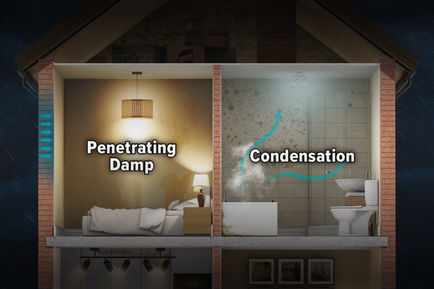
Condensation-related moisture commonly appears on cold surfaces, around windows, in external corners, behind furniture or in rooms where moisture is regularly produced. However, symptoms alone are not enough to confirm the cause. Damp patches that worsen after rainfall, rises from ground level or presents near plumbing may indicate penetrating damp, rising damp or a leak and should be investigated separately.
A house can be insulated at roof, wall or floor level. The right method depends on the building’s age, construction and condition. Damp, ventilation and moisture risks should be assessed before work begins.
Everyday activities add moisture to the air inside a home. Cooking, showering, washing, drying laundry and breathing all release water vapour. In a well-ventilated property, most of this moisture is directed out of the building before it can settle.
When ventilation is poor, moisture-laden air can become trapped indoors. As this warm, humid air meets colder surfaces, it cools to form condensation on windows, external walls, ceilings and corners. If this happens repeatedly, the resulting damp conditions make mould growth more likely.
Ventilation helps reduce this risk by moving humid air out of the property and replacing it with fresh air. This is particularly important in kitchens, bathrooms, utility rooms, bedrooms and other areas where moisture can build up quickly.
However, ventilation is only one part of moisture control. Heating patterns, insulation, surface temperature, occupancy, drying habits and the condition of the building fabric can all affect condensation and mould risk. Leaks, penetrating damp and rising damp should also be ruled out where damp patches, staining or mould keep returning.
The aim is not simply to ventilate more, but to ventilate appropriately. A home needs enough fresh air movement to control moisture and support indoor air quality without creating unnecessary draughts, heat loss or discomfort.
Poor ventilation may not always be obvious at first. In many homes, the first warning signs appear when moisture-laden air is unable to escape and begins to condense on colder surfaces.
Condensation on the inside of windows is very common, especially in the morning or after cooking, showering or drying laundry indoors. Small amounts of occasional condensation is generally normal, but frequent or persistent condensation indicates that moisture is not being removed effectively.
Mould growth can also indicate poor ventilation, particularly when it appears around windows, on external walls, behind furniture, in corners, on ceilings or around bathroom sealant. These areas are often colder or have limited air movement, making them more likely to stay damp after condensation forms.
Other signs include musty smells, moist air, peeling paint, damaged wallpaper, mouldy sealant and surfaces that take a long time to dry after normal use. If steam lingers in bathrooms, kitchens and utility rooms, you may need to assess how, and if, extract ventilation is being used. If it is present, you may need to upgrade your system or set it to run for longer.
The condition of the ventilation system itself should also be checked. Check extract fans for blockages, excessive noise, weak power or loose fitted ducting and ensure that trickle vents are open and clear.
The above signs can point towards a ventilation or condensation problem, but they should not be used as a diagnosis on their own. Damp patches, staining and mould can also be caused by leaks, penetrating damp, rising damp, cold bridging or building fabric defects. If symptoms keep returning, identify the source of moisture before choosing a ventilation, repair or damp treatment measure.
If ventilation is missing, blocked, poorly positioned or not suited to the way the home is used, moisture can build up in the home. You must also take into account how many people occupy the property and how old they are. A growing family of four will generate more moisture over time, as children grow into adults.
One common issue is poor extract ventilation in kitchens, bathrooms and utility rooms. These rooms produce high levels of moisture in short periods of time. If an extractor fan is missing, weak, noisy, blocked, switched off too soon or ducted incorrectly, humid air can become trapped in the room or spread through the rest of the property.
Background ventilation can also be affected. Trickle vents may be closed, painted shut or obstructed. Air bricks, grilles and other ventilators can become blocked by dirt, furniture, or retrofit works like insulation measures. Where replacement windows have been installed, the original ventilation pattern may also have changed.
Airflow between rooms is another important factor to consider. Internal doors, fitted carpets, draught excluders and altered layouts can all restrict the movement of air through the home. This can leave moisture trapped in bedrooms, cupboards, corners, behind furniture and other areas where air movement is limited.
Some systems appear to ventilate a room but do not remove moisture from the building. A recirculating cooker hood, for example, may filter grease and odours, but it does not discharge humid air outside. Mechanical systems also need to be activated at the right time, regularly maintained and connected to a source of adequate replacement air to work effectively.
Ventilation problems can also appear after retrofit or refurbishment work. Insulation, draught proofing, new windows and other energy efficiency upgrades can improve comfort, but they may also reduce uncontrolled air leakage. Where a home becomes more airtight, re-assess ventilation measures so moisture can still be removed effectively.
The aim is not to create draughts or leave windows open all day. Good ventilation should provide a controlled route for fresh air to enter and moisture-laden air to leave. If condensation, mould or musty odours keep returning, the ventilation provision should be checked alongside heating, insulation, surface temperatures and possible sources of damp.
Passive vents allow air to move through the building without a fan. Common examples include trickle vents in windows, air bricks, wall vents and background ventilators. They can help support steady air movement, but their performance depends on wind, temperature difference, building layout and whether the vents are open, clear and correctly positioned.
Passive ventilation is often useful as part of a wider ventilation approach, especially where fresh replacement air is needed. However, passive vents alone may not be enough in rooms where moisture is produced quickly, such as bathrooms, kitchens and utility rooms.
Intermittent extract fans are wall, ceiling or window fans often fitted in bathrooms, kitchens and utility rooms. They switch on when needed, usually through a light switch or humidity sensor, then run for a set period.
These fans help remove humid air close to the source, but their effectiveness depends on correct sizing, ducting, positioning and operational pattern. A fan that is weak, blocked, noisy, ducted poorly or turns off too soon may leave moisture in the room or allow it to spread through the property.
A dMEV system uses individual low-energy extract fans, normally fitted in wet rooms, to provide continuous background extraction. Many dMEV fans run at a low speed most of the time, then boost when moisture levels rise.
This type of system can provide more consistent extract ventilation than a standard intermittent fan. It can be useful where condensation is linked to regular moisture production in bathrooms, kitchens or utility rooms. dMEV fans still need clear ducts, suitable air paths and appropriate background ventilation so replacement air can enter the home.
In-line fans are usually sited within a loft void or ceiling space, rather than directly on the wall or ceiling grille. The fan itself sits directly within the length of ducting, rather than at one end of it.
They are useful for bathrooms, shower rooms and other areas where higher extraction performance is required or concealment of the fan system itself is important for space or aesthetic reasons. As with any extract system, performance depends on the fan specification, duct length, duct route, grille position and whether the duct discharges outside.
Positive Input Ventilation (PIV) systems introduce filtered air into the property, usually from the loft space. This incoming air helps dilute and displace stale, humid indoor air through natural leakage points in the building and existing ventilation routes such as windows and passive vents.
PIV can be beneficial in suitable homes where condensation and mould are linked to poor whole-house air movement. It is most often considered for properties where moisture is not confined to one wet room, but appears across several areas of the home. It should be selected carefully and does not remove the need for appropriate extract ventilation in kitchens, bathrooms and utility rooms.
Continuous Mechanical Extract Ventilation removes air from wet rooms on an ongoing basis. This may be achieved through separate decentralised fans, such as dMEV units, or through a central extract unit connected to multiple rooms by ducting.
This approach can help maintain more consistent moisture removal than intermittent extraction alone. It is particularly relevant in areas of high moisture generation that short fan cycles struggle to cope with.
Mechanical Ventilation with Heat Recovery (MVHR) systems supply fresh air to living spaces and extract stale air from wet rooms through a ducted system. Heat from the outgoing air is transferred to the incoming air to reduce heat loss.
MVHR is most commonly used in airtight homes, new-build properties and deeper retrofit projects. It requires careful design, installation, commissioning and maintenance. In a leaky or unsuitable building, it may not perform as intended.
A dehumidifier is not a ventilation system because it does not bring fresh air into the property or remove stale air to outside. However, it can complement an existing ventilation system. Dehumidifiers remove water vapour from indoor air and collect it as liquid water, which is then disposed of.
Dehumidifiers can be useful as a supporting measure, particularly for laundry drying or short-term humidity control. However, they should not be treated as a substitute for effective ventilation, suitable heating or repairs to the building fabric.
No single ventilation system is right for every property. A bathroom with poor extract may need a different solution from a home with whole-house condensation after window replacement, insulation or draught-proofing work.
Before choosing a system, assess the home thoroughly to understand how moisture is being produced, where it is collecting and how air currently moves through the building. The overall goal is always to provide controlled ventilation that removes moisture effectively without creating unnecessary draughts, heat loss, noise or discomfort.
The right ventilation approach depends on where moisture is coming from, where symptoms are appearing and how air currently moves through the property. A home with persistent bathroom condensation may need a different solution from a home with mould in several rooms or damp patches caused by penetrating or traumatic damp, for instance.
The first step is to identify the moisture source. Cooking, showering, washing, drying laundry and normal occupancy all release water vapour into the air. If this moisture is not removed effectively, condensation may form on cold surfaces. However, damp and mould is also linked to leaks, penetrating damp, rising damp, defective rainwater goods, cold bridging, faults in the building fabric, and more. All necessary repairs should be carried out before choosing a ventilation approach.
The next step is to look at where the problem is occurring. Moisture limited to a bathroom, kitchen, WC or utility room may point towards poor local extract ventilation. This could mean an extractor fan is missing, too weak, blocked, poorly ducted or not running for long enough. In these cases, an intermittent extract fan, in-line fan or dMEV fan may be appropriate, depending on the room and duct route.
Where condensation, musty smells or mould appear across several rooms, the issue may be linked to poor whole-house air movement. Background ventilators, trickle vents, passive vents or Positive Input Ventilation may help improve general airflow in suitable properties. The existing routes for air to enter, move through and leave the building should be checked before a system is chosen.
The building’s condition also matters. Homes that have had new windows, insulation, draught-proofing or other retrofit work may be more airtight than before. These upgrades can improve comfort and energy performance, but they can also change how moisture leaves the property. Ventilation should be reviewed whenever building work alters the airflow of the home.
Heating and surface temperature should be considered alongside ventilation. Condensation forms more readily on cold surfaces, so poor insulation, thermal bridging, unheated rooms and furniture placed tight against external walls can all increase mould risk. In these cases, ventilation may need to be combined with suitable heating, insulation or changes to room layout.
If the home’s symptoms keep returning, the property should be assessed as a whole. Ventilation, heating, insulation, occupancy, moisture production and possible building defects all need to be considered before choosing a system or treatment.
Condensation risk is affected by both the amount of moisture in the air and the temperature of the surfaces around it. Warm air can hold more water vapour than cold air. As air cools, its Relative Humidity (RH) rises. If it cools enough, it reaches the point where it can no longer hold all of its moisture as vapour, and water begins to form on colder surfaces.
This is why condensation often appears on windows, external walls, ceilings, corners, reveals and areas behind furniture. These surfaces are usually colder than the surrounding air, especially in winter or in rooms with limited heat and poor air movement.
Relative Humidity (RH) describes how close the air is to being saturated with water vapour at its current temperature. A room can contain the same amount of moisture, but the relative humidity will rise if the air temperature falls. This means a room may become more prone to condensation overnight, even if no additional moisture has been added. This is why it is important to manage temperature alongside RH.
Ventilation helps by removing moisture-laden air and replacing it with fresh air. Heating and insulation also matter because they influence air temperature and surface temperature. A well-ventilated room can still suffer from condensation if surfaces remain cold, while a warmer room can still develop moisture problems if humid air is not removed.
Mould is more likely to develop where surfaces stay damp for long enough to support growth. This commonly happens in cold, still or poorly ventilated areas, like windows, ceiling corners, behind wardrobes, in bathrooms and kitchens.
The aim is to control the conditions that allow condensation and mould to develop. This usually means reducing excess moisture, improving ventilation, maintaining suitable heating, increasing surface temperatures where possible and checking that damp is not being caused by leaks, penetrating damp, rising damp or other building defects.
Retrofit work can change how air and moisture move through a home. Insulation, draught-proofing, replacement windows and other energy-efficiency upgrades can improve comfort and reduce heat loss, but they may also reduce the uncontrolled air leakage that previously allowed moisture to escape.
This does not mean a property should be left draughty. Gaps, cracks and open windows are not a reliable ventilation strategy. The aim is to replace uncontrolled air leakage with suitable, controlled ventilation that allows fresh air in and moisture-laden air out without unnecessary draughts or heat loss.
When undertaking retrofit measures of any kind to your home, ventilation measures should be considered. Insulation and draught-proofing can alter surface temperatures, air movement and drying potential.
Internal wall insulation, in particular, may increase moisture risk, because poor detailing or inadequate ventilation can contribute to surface condensation, interstitial condensation and mould growth.
A holistic, whole-property approach is important. Before major retrofit work is carried out, the building should be checked for existing dampness, water ingress, defective rainwater goods, leaks and other moisture sources. Improving airtightness without addressing these problems can make moisture-related defects more difficult to manage.
Installation and commissioning also matter. Mechanical ventilation systems need clear ducts, correct controls, suitable airflow routes and maintenance access. Passive vents need to remain open and unobstructed. Any ventilation system installed as part of retrofit works should be set up, explained and handed over properly by the contractor so it continues to work as intended.
The safest approach to retrofitting your home for any reason involves considering ventilation, insulation, heating and damp diagnosis together. Retrofit should make the home more comfortable and resilient, while still allowing the building to manage moisture effectively.
The Dryzone Ventilation range includes a range of mechanical extract ventilation and passive ventilation solutions to suit different properties and moisture-control requirements.
The right ventilation system depends on where moisture is collecting, how air currently moves through the property and whether the problem affects one room or several areas of the home. Other sources of dampness should be ruled out before designing the right ventilation system.
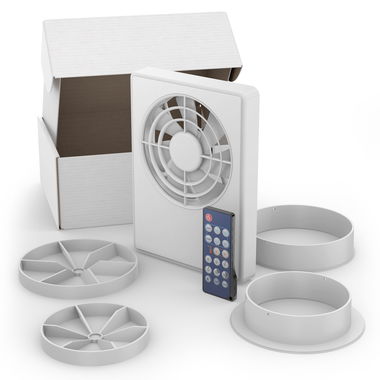
The Dryzone Bathroom & Kitchen dMEV Fan provides continuous mechanical extraction from wet rooms. It runs at a low background flow rate during normal conditions and automatically increases its extraction rate when the integral humidity sensor detects a rise in moisture. It is designed for bathrooms, kitchens and utility rooms where regular moisture production requires consistent extraction.
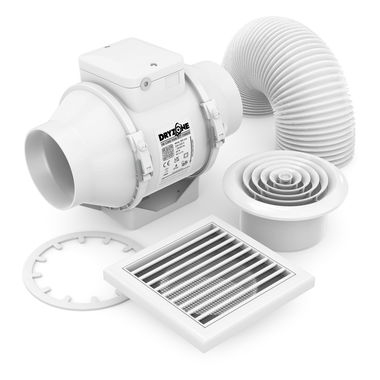
The Dryzone In-Line Fan Kit with Timer is installed within a loft or ceiling void rather than directly on the room surface. It extracts humid air through ducting and continues to run for an adjustable period after it has been activated. Positioning the fan away from the room also helps reduce the noise heard by occupants. The kit includes internal and external grilles, flexible ducting and the components required for installation.
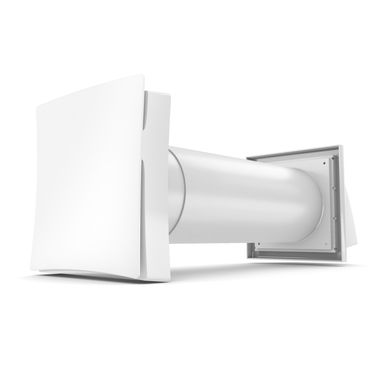
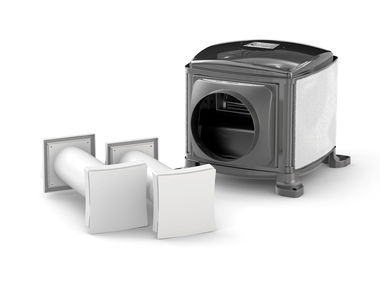
The Dryzone Telescopic Passive Wall Vent provides a controlled route for background air movement through an external wall. It requires no electrical supply and has no mechanical parts. An adjustable internal shutter allows the airflow to be regulated, while the telescopic duct accommodates a range of wall thicknesses.
Passive wall vents are generally intended for habitable spaces such as bedrooms and living rooms. They can provide replacement air for extract systems or support wider air movement through the property. Their performance depends on pressure differences, weather conditions, positioning and the availability of other airflow routes.
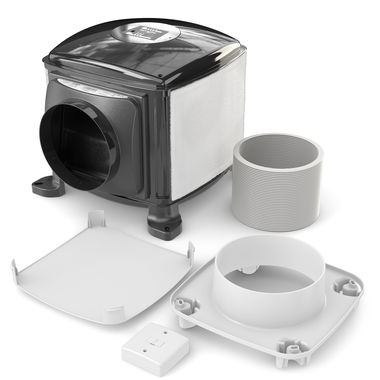
The Dryzone Loft Cube PIV Kit with Heater introduces filtered air from a clean, ventilated loft space into a central area of the home. This incoming air helps dilute and displace humid indoor air through existing ventilation routes such as windows, trickle and passive vents.
Four selectable settings allow the airflow to be matched to the property, while the integral heater tempers incoming air during colder conditions. The on-board ISO Course 65% filter is replaceable. The system is intended for suitable homes with loft access and a cold pitched roof. It is particularly relevant where condensation, musty air or mould affects several rooms rather than one isolated wet area.
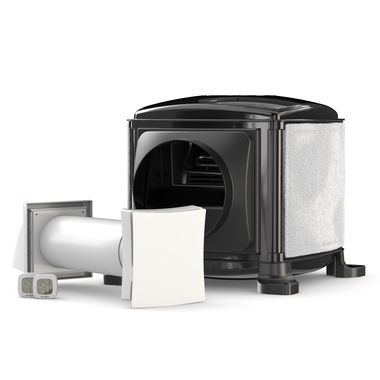
The Dryzone Positive Input & Passive Ventilation Kit combines the Loft Cube PIV with two, three or four Dryzone Telescopic Passive Wall Vents. The PIV supplies filtered air centrally, while the passive vents provide additional airflow routes in individual rooms.
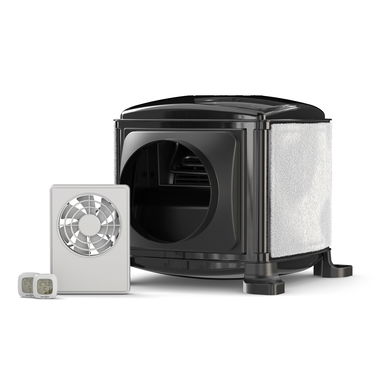
The Dryzone PIV with dMEV Fan & 2 Hygrometers combines whole-home positive input ventilation with continuous humidity-responsive extraction from a wet room. Two hygrometers allow temperature and relative humidity to be observed in different parts of the property.
The Dryzone PIV with Passive Vent & 2 Hygrometers combines the Loft Cube PIV, one Telescopic Passive Wall Vent and two hygrometers. It is intended to support whole-home air movement, provide additional background ventilation in a selected room and allow indoor conditions to be monitored.
Where visible mould is already present, ventilation improvements can be combined with products for treating affected surfaces.
Localised moisture in a bathroom or kitchen may require improved extract ventilation. Condensation across several rooms may indicate a need to review whole-home airflow, background ventilation and heating. Some properties may benefit from a combination of positive input ventilation, passive vents and wet-room extraction.
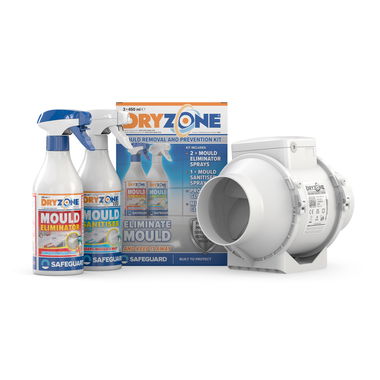
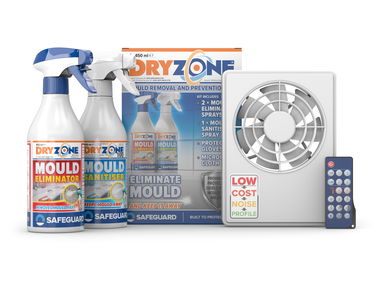
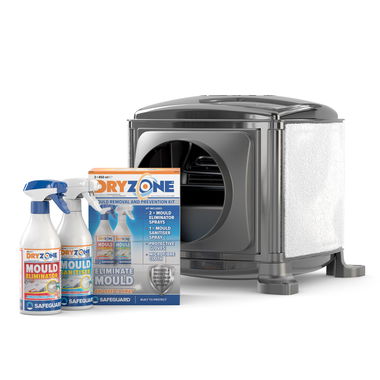
The Dryzone dMEV Fan and Mould Removal & Prevention Kit combines continuous wet-room extraction with a two-stage treatment for visible mould. The Dryzone In-Line Fan and Mould Removal & Prevention Kit provides a similar treatment package alongside ducted, timer-controlled extraction.
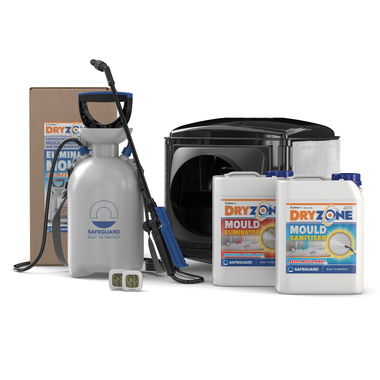
For properties requiring whole-home ventilation, the Dryzone PIV and Mould Removal & Prevention Kit combines the Loft Cube PIV with the domestic mould-treatment system. The Dryzone PIV, Pro Mould Kit & 2 Hygrometers includes a professional-grade mould-treatment kit for larger affected areas, together with two hygrometers for ongoing monitoring.
Mould treatment should follow investigation of the moisture source. Keep in mind that removing visible mould and mildew will not prevent it from returning if condensation, active leaks, cold surfaces or inadequate ventilation remain unresolved.
Mechanical ventilation should be installed and commissioned by a competent person in accordance with the manufacturer’s instructions, the applicable Building Regulations and the requirements of the individual project. Airflow routes, electrical work, ducting, controls and future maintenance should all be considered during installation.
How can we help?
Related Pages
Get it Done

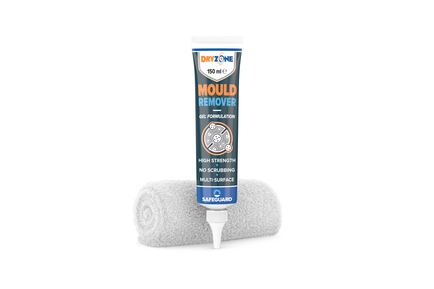
Remove stubborn mould stains from hard-to-clean areas with Dryzone Mould Remover Gel.
Read More
Although mould often becomes visible during colder months, the conditions that allow it to develop may exist long before winter arrives. Taking action during summer can reduce the risk of complaints, protect the condition of the property and help keep accommodation healthy and comfortable for tenants.Here are five practical steps to take before the new academic year begins:
Read More
Keeping mobile, TV & laptop screens clean is important for productivity & hygiene. Here are five rules for cleaning screens perfectly.
Read More
Reduce plastic use on site with Stormdry Masonry Protection Cream - now available in 20L Eco packaging.
Read More
Wasps, hornets and nests cause big problems in summer. Read this to find out how to locate, identify and get rid of wasps and hornets.
Read More
Find out how we helped dry out this 18th century Grade II listed mill house renovation in the New Forest
Read More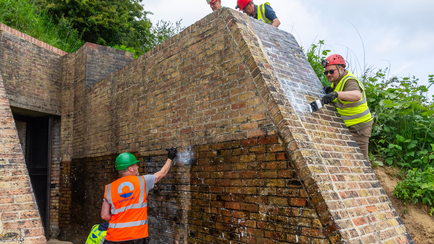
Discover how Stormdry Masonry Protection Cream was used on World War 2-era gun battery magazine buttresses at Dover.
Read More
With Tibby Singh and YDC Basements, Safeguard waterproofed a basement at an end of terrace home in Leeds using Drybase Tanking System.
Read MoreSubscribe to get information about products and offers.